Educational reasoning lab

Train the habits behind clear thinking

Solvexis is a structured environment for logic practice: puzzles that teach principles, strategies you can reuse, and exercises designed to build stamina without burnout.

Abstract grid puzzle showing a highlighted logical path through cells.
Good puzzles compress big ideas into small, testable moves.

Why logic training matters

Reasoning is a craft. Like physical training, it responds to repetition, feedback, and progressive difficulty.

Transferable structure, not trivia

From premises to conclusions

Logic training is valuable because it strengthens the movable parts of thought: identifying what follows, what conflicts, and what remains unknown. When you practice extracting structure from messy information, you become less dependent on memorized facts and more resilient in unfamiliar domains. That matters for academic work, technical troubleshooting, and everyday decisions where the “right answer” is not handed to you as a multiple-choice item.

Training also builds metacognitive control—the ability to notice when you are guessing, when you are overconfident, and when you need to slow down. People often assume intelligence is fixed; in practice, measurable gains come from deliberate practice with clear criteria: correctness, explicit justification, and the habit of checking edge cases.

Finally, logic practice pairs naturally with communication. When you can separate definitions from assumptions from conclusions, you reduce misunderstandings in teams and classrooms. Solvexis frames exercises so that “show your reasoning” is not a chore—it is the core skill being strengthened.

Practice cue: After each attempt, write one sentence: “What rule did I use?” If you cannot name it, the solution is not yet stable.

Common thinking mistakes

Recognizing failure modes is the fastest way to prevent them from becoming habits.

Confirmation drift

Noticing only what fits your story

Confirmation drift happens when you treat a hypothesis as true because it feels coherent, then interpret new evidence generously. In puzzle settings, it shows up as “I’m sure it’s X” followed by loose checking. The corrective habit is disconfirmation: ask what observation would prove you wrong, and search for that observation early.

Related patterns include anchoring (over-weighting the first plausible idea) and availability bias (mistaking vivid examples for representative data). Training reduces these errors by forcing explicit alternatives: list two competing hypotheses before committing.

Category collapse

Mixing levels of analysis

Category collapse is switching between informal language and formal rules without noticing. In logic puzzles, it appears as vague quantifiers (“most,” “usually”) sneaking into a domain that requires crisp definitions. The fix is to tabulate: write entities in rows and properties in columns, then fill cells only from stated facts.

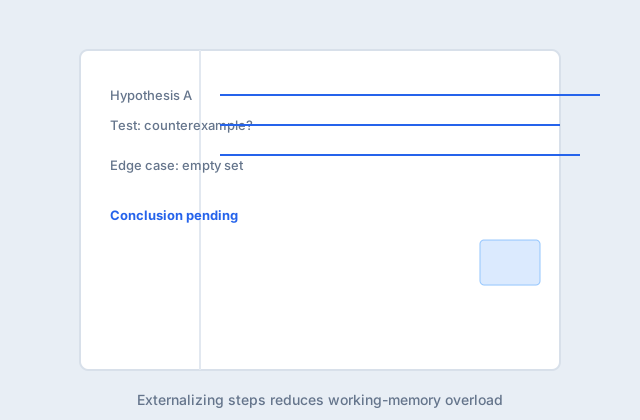
Illustration of a notebook with margin notes testing hypotheses.
Writing down alternatives makes confirmation drift easier to spot.

Sample tracks that show how difficulty scales through constraints—not through obscurity.

Constraint propagation suite

Grid deduction · ordering · uniqueness checks

This featured track centers on puzzles where each clue eliminates branches until only consistent assignments remain. Early problems teach single-point deductions (a cell forced by a row/column rule). Mid-level sets introduce intersection reasoning—two constraints meeting in a narrow region. Advanced items require global consistency: you may need to maintain multiple hypothetical states briefly, then discard the ones that contradict a deep constraint.

What makes these challenges educational is the audit trail: you are encouraged to state which rule fired at each step. That habit converts “I solved it” into “I can re-solve it,” which is the practical definition of understanding.

Read how puzzle types map to skills →

Argument reconstruction

Identify premises, gaps, and hidden assumptions

Short passages present claims that sound persuasive until you separate support from rhetoric. The task is to reconstruct the argument as a diagram: premises on the left, conclusions on the right, and explicit inference steps in the middle. The “challenge” is not speed-reading—it is resisting the urge to fill gaps with goodwill.

Featured items include missing quantifier problems (when does “many” imply “most”?) and scope shifts (a term used in one sense early and another sense later). These are common in real-world writing; training here sharpens professional judgment.

See problem-solving workflows →

Daily exercises

Small, repeatable sessions beat occasional marathons—especially for reasoning stamina.

How daily practice is structured

Micro-drills · weekly themes · reflection prompts

Daily exercises on Solvexis are designed around cognitive load management. Each day typically includes a five-minute warm-up (a single deduction), a twelve-minute core item (a two-step integration), and a two-minute reflection prompt. The reflection is not fluff—it asks you to name the principle you used, which is how separate days connect into a curriculum.

Weekly themes rotate through domains: ordering, invariants, parity, double negation, and set intersection. Rotation prevents narrow drilling while still allowing enough repetition for skills to consolidate.

  • Monday–Tuesday: precision and reading discipline
  • Wednesday–Thursday: integration and multi-step planning
  • Friday: mixed review with a harder “stretch” prompt
  • Weekend: optional deep dive article connections

If you miss a day, the next session still works: difficulty adjusts from recovery mode rather than punishing gaps with overload.

Open the daily exercises guide

Diagram showing premises feeding an inference rule toward a conclusion.
Daily drills connect micro-skills to explicit inference patterns.